ROM (Read-Only) - Non-volatile
Small permanent memory that holds small program called the bootstrap - Looks for OS when "Booting"
RAM (Random Access Memory) - Volatile
Holds OS / Data / Programs that are IN USE.
Emptied when PC is switched off
Tuesday, 29 March 2011

Sunday, 27 March 2011
Archiving and Backing Up
Archiving
- Archiving is done less frequently
- Cheap Media
- Is current Data that may be required immediately
Random Access
- Follows an hashing algorithm to store every piece of data is stored in a specific location
- Very Fast
- If it is not complicated enough it can result in clashes
Index Sequential Storage

XXX (400) = Visa +
X (0)= Country +
XX (12) = Bank +
XX = (34) Branch +
XXXX (5678) =
XXXX (9123)
- Quick Response
Seqential Storage
Structured way of saving and locating information
e.g. (A-Z), (0-1000000)
slower to save
quicker to locate
e.g. (A-Z), (0-1000000)
slower to save
quicker to locate
Serial Storge
Saving to Serial Storage (Tape)
Slow to load
Full to save
Takes long to load
Brilliant for saving (Back Up)
Lack of Structure
Cheapest method for saving
Physical method of storage
Slow to load
Full to save
Takes long to load
Brilliant for saving (Back Up)
Lack of Structure
Cheapest method for saving
Physical method of storage
1.3 Fixed Length Records
Each field limited to:
- Name - 255
- Age - 8 (integer)
- Price - 16 (decimal)
- Boolean - (1 bit)
FIFO and LIFO
FIFO First in First out
an abstraction in ways of organizing and manipulation of data relative to time and prioritization. This expression describes the principle of a queue processing technique or servicing conflicting demands.
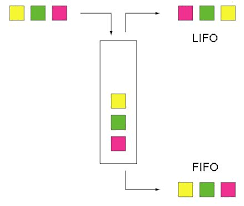
Queues = First in first out
Queues have two pointers : Head pointer, Tale Pointer
Example:
Print Queue
LIFO Last in First out
This refers to the way items stored in some types of data structures are processed. By definition, in a LIFO structured linear list, elements can be added or taken off from only one end, called the "top" A LIFO structure can be illustrated with the example of a stack of trays. The last tray to be placed on top is also the first to be taken off the top

an abstraction in ways of organizing and manipulation of data relative to time and prioritization. This expression describes the principle of a queue processing technique or servicing conflicting demands.
Queues = First in first out
Queues have two pointers : Head pointer, Tale Pointer
Example:
Print Queue
LIFO Last in First out
This refers to the way items stored in some types of data structures are processed. By definition, in a LIFO structured linear list, elements can be added or taken off from only one end, called the "top" A LIFO structure can be illustrated with the example of a stack of trays. The last tray to be placed on top is also the first to be taken off the top

Sunday, 20 March 2011
Homework
The school awards a prize each year to the students who achieve the highest mean mark in
their form.
Produce an algorithm for a procedure called PRIZE which will determine which student will
win the prize for a particular form. The name of the form and the name of the student should
then be saved to a file called PRIZES.
(You should use MEAN in this final algorithm without reproducing the detail in part (a).)
their form.
Produce an algorithm for a procedure called PRIZE which will determine which student will
win the prize for a particular form. The name of the form and the name of the student should
then be saved to a file called PRIZES.
(You should use MEAN in this final algorithm without reproducing the detail in part (a).)
AS Paper 1 questions
Students take exams in all their subjects at the end of every year. A procedure is to be written which inputs the marks of a student from the STUDENT file and calculates the mean
mark for that student.
Produce an algorithm which will carry out the above task. The procedure is to be called
MEAN.
✔Procedure mean
✔Number of marks = 0
Total = 0
✔Do While you've still got marks
Read Mark
✔Number = Number + 1
Total = Total + Mark
EndWhile
✔Average = Total/Numbered Mark
End
mark for that student.
Produce an algorithm which will carry out the above task. The procedure is to be called
MEAN.
✔Procedure mean
✔Number of marks = 0
Total = 0
✔Do While you've still got marks
Read Mark
✔Number = Number + 1
Total = Total + Mark
EndWhile
✔Average = Total/Numbered Mark
End
Sunday, 13 March 2011
What are WIKI'"s, Blog's, Micro Blog's and RSS
What are WIKI'"s, Blog's, Micro Blog's and RSS
Blog: A web-based mechanism to allow an open discussion on a topic. http://www.farq.co.nz/ (for a laugh!) Alternatively, you could try a more traditional blog site e.g. http://transportblog.co.nz/
Micro blogging: Similar to a Blog, except the comments are usually smallier in size. An example would be http://twitter.com/
RSS: “Real Simple Syndication”. It is a format used to disseminate information in a standard way. It is based on XML. Most news websites have RSS feeds available, e.g. http://snowreports.co.nz/syndication/xml/allfields_brief.cfm
AS Computing Science - Procedures and Functions
Procedures and Functions
procedures and functions are features of any programming language which allow you to repeat a certain piece of code or calculation again and again. They also help modulate code, so that they can be called from many places in a program.
procedures and functions are features of any programming language which allow you to repeat a certain piece of code or calculation again and again. They also help modulate code, so that they can be called from many places in a program.
Wednesday, 9 March 2011
Oscars Moment
Today Oscar made my day.
We were doing a binary exercise and Mr Wells asked him to write 94 in binary code
Instead Oscar decided to write
94 on the board
LOL
We were doing a binary exercise and Mr Wells asked him to write 94 in binary code
128 64 32 16 8 4 2 1
0 1 0 1 1 1 1 0
Instead Oscar decided to write
94 on the board
LOL
Sunday, 6 March 2011
Describe the characteristics of different types of operating systems and their uses:
- Batch
- A Batch OS is operating system which analyzes your input into the system and then groups them into batch's according to different characteristics e.g. Printing Power Bills
- Real-time
- A real-time operating system (RTOS) is an operating system intended to serve real-time application requests and process them straight away e.g POS (Point of Sale)
- Single-user
- Single-user operating systems are designed to manage the computer so that one user can effectively and effiently do one thing at a time e.g The Palm OS for Palm handheld computers
- Multi-user
- Multi-user operating systems allows many different users to take use the computer's resources, programs etc. simultaneously.
Wednesday, 2 March 2011
Hardware Software
Input
Process
Output
Storage
CPU talks to ram as it runs at such a fast speed it cannot talk to the hard drive
Software
Software = sets of instructions which tell the system how to do something. These instructions are collected together in a workable group which is called a program.
Operating system
Process
Output
Storage
CPU talks to ram as it runs at such a fast speed it cannot talk to the hard drive
Software
Software = sets of instructions which tell the system how to do something. These instructions are collected together in a workable group which is called a program.
Operating system
- User interface software
- Provides a GUI
- Provides a platform for apps to go on it
- Translate Software (TS)
- An OS provides its own TS
- Translate high level language into machine 'Code' - source code to the object code
- Utilities
- Allows you to change the system to a certain extent
- Common Applications (Any app that is used around the world
- iPhoto
- Garageband
- iMovie
- Generic Applications
- Pages
- Word
- Custom Software
- Made for a unique task e.g.making posters
- Off the Shelf Software (bought from a shop)
Subscribe to:
Posts (Atom)